About Us


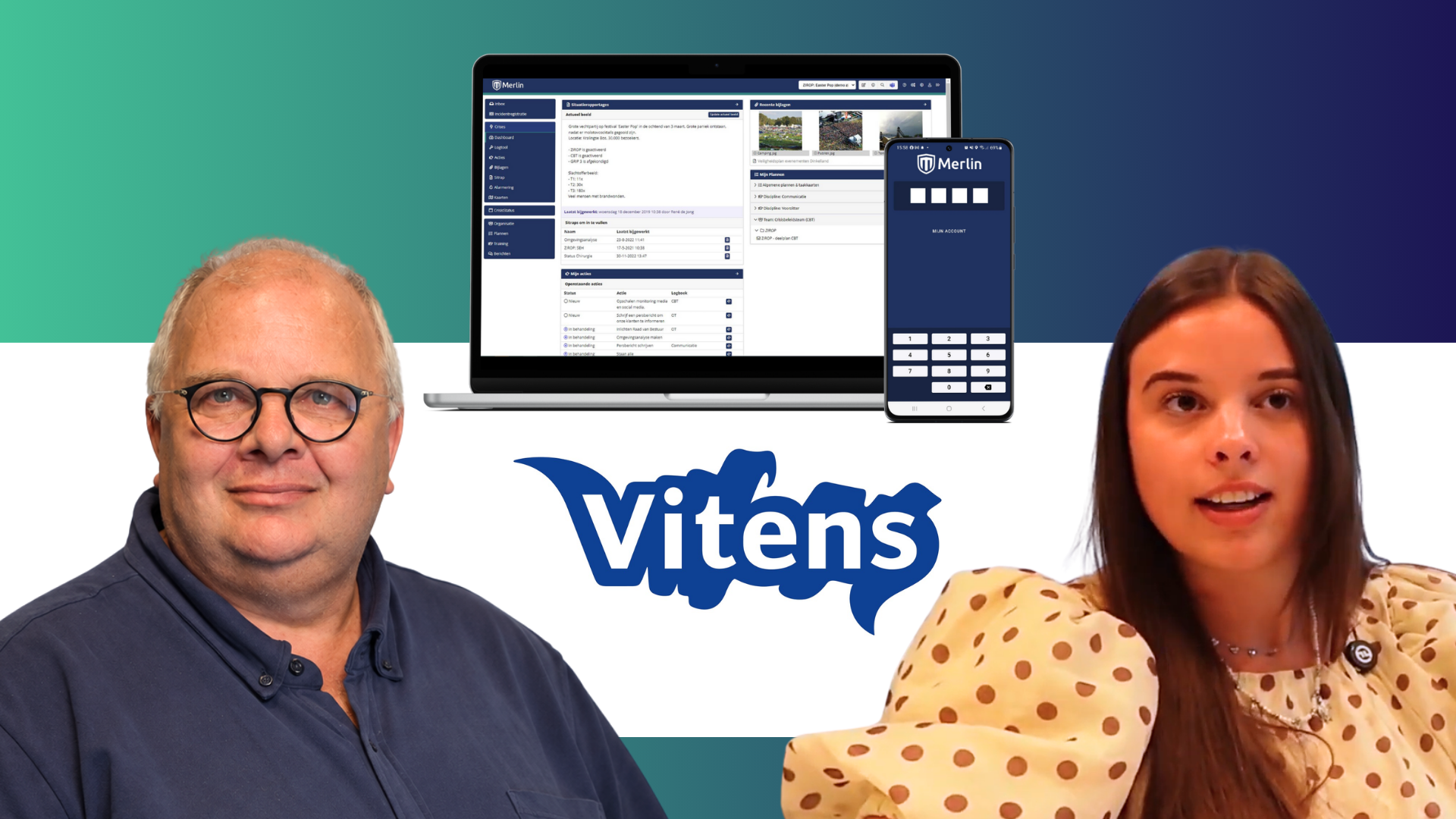
Vitens is the largest drinking water company in the Netherlands and supplies drinking water to five provinces, covering about one-third of the country. Given its size, the company experiences daily disruptions and incidents. Peter Kloosterman and Nikki Wagenvoort, both crisis management consultants at Vitens, explain how the crisis management organization is structured to handle these situations and what role CrisisSuite they play in it.
Vitens already had an internal crisis management team, but the tools supporting it were fragmented. “Without CrisisSuite , we actually had a bit of a mess of all the different programs we were using for that,” says Peter. “Excel, Outlook, Teams. And we had a custom-developed emergency app.”
When it came time to replace that app, that was the moment to take a bigger step. “If we’re going to make changes anyway, we might as well take a big leap forward. And that simply means working in a truly network-centric way, with everything integrated as much as possible. That’s how we ended up with CrisisSuite.”
One of the things Vitens noticed right away was the integration of the on-call schedules. Nikki: “On-call employees who use CrisisSuite can now swap shifts themselves and keep track of their own schedules. That saves us a lot of work. And the phone numbers are automatically forwarded—that’s a service CrisisSuite also provides. That entire package solves a lot of problems for us.”
In addition, Vitens uses the Incidents module. The dispatchers create an incident in the system and select the incident type: contamination, a pipe break, a production disruption, or a power outage. “An incident form is automatically linked to each type,” Nikki explains. “This immediately provides a complete initial overview based on the type of incident you’re dealing with. We think that’s a really great added value.”
If an incident escalates, Vitens treats it as a crisis and scales up its response. This also happens at CrisisSuite. "You get a logging tool ," says Peter. "You can neatly separate the logs from the operations team and the policy team, and you can add attachments. Having all the information in one place is a real advantage. We used to have to search through all kinds of files and folders."
CrisisSuite is used daily at Vitens. “Last week, for example, five incidents were logged, one of which escalated into a crisis. All the information is then available at the right place at the right time.”
In early April, Vitens faced a major pipeline incident near Apeldoorn that escalated into a crisis. The company had just started using CrisisSuite at the time. “It took some getting used to for many people in the crisis response team, because things were naturally handled differently,” says Nikki. “But you could see that it provided support, because the log tool is very well organized according to the BOB structure.”
During the crisis, meetings followed one after another in rapid succession. “I had CrisisSuite open the whole time. Tasks could be easily assigned to the various people involved. Many photos were taken and attached as files, which immediately provided a much clearer picture. Our crisis team was working remotely, after all. The current situation could be updated quickly each time, and that was important because it was actually changing every hour.”
Vitens has found working with Merlin to be a pleasant experience, starting right from the search for the right program. “They’re always easy to reach, and I can really bounce ideas off them,” says Nikki. “If we run into a problem, we always work together to find a solution. Merlin helps us figure out what’s possible and what isn’t. That makes for a great partnership.”
Peter sums it up: "It really comes down to this: we want to deliver a good program. I really like that."

.jpg)

